


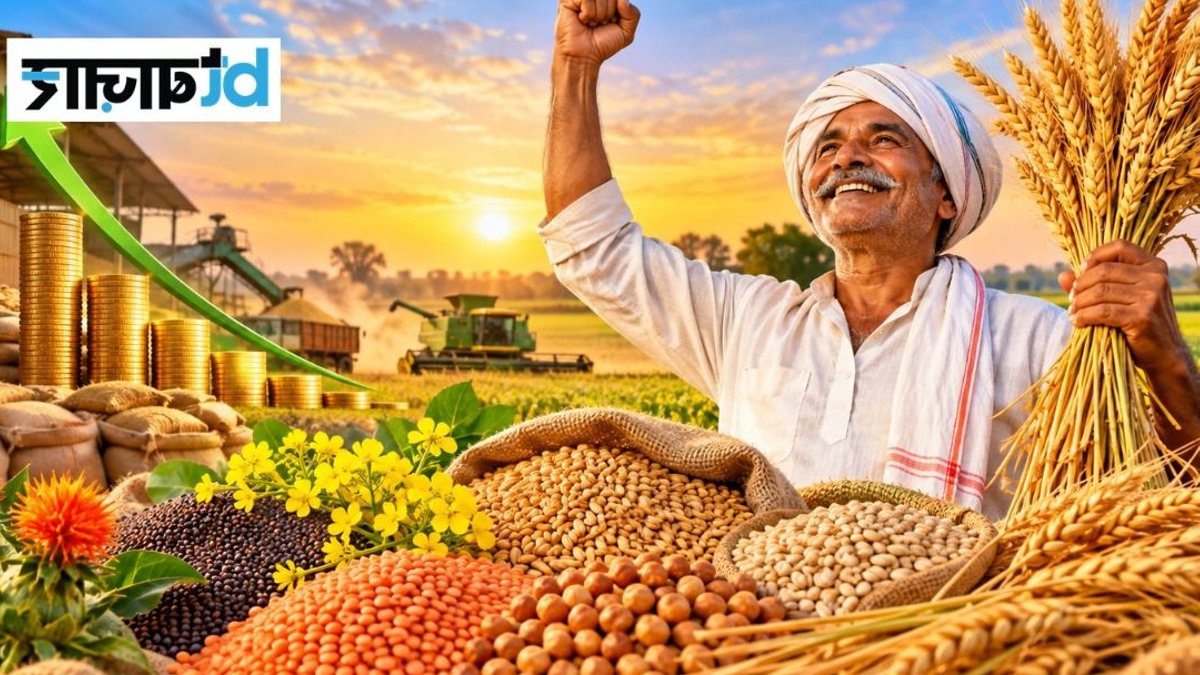
The Indian government has approved increased minimum support prices (MSP) for six key rabi crops ahead of the 2027-28 marketing season, with adjustments ranging from 25 to 675 rupees per quintal. This decision, announced by the Cabinet Committee on Economic Affairs (CCEA), seeks to boost farmer earnings by improving returns on wheat, barley, chickpea, lentils, mustard, and kusum.
Wheat’s MSP has been set at 2,610 rupees per quintal, a 25-rupee increase from the previous season. Barley’s price rises by 136 rupees to 2,286 rupees per quintal, while chickpea (chana) increases by 83 rupees to 5,958 rupees per quintal. Lentils (masoor) see a 390-rupee rise to 7,390 rupees per quintal, and mustard, including rapeseed, goes up by 413 rupees to 6,613 rupees per quintal.
The most significant adjustment is for kusum, whose MSP jumps by 675 rupees to 7,215 rupees per quintal. According to the government, these rates meet its policy of setting MSP at least 1.5 times the average production cost. The profit margins now stand at 106% for wheat, 96% for mustard, 92% for lentils, 59% for chickpea, 58% for barley, and 50% for kusum.
Read Also: Indian stocks plunge to six-month lows on global pressures
Farmers cultivating wheat have already seen higher procurement volumes. Between 2014-15 and 2025-26, wheat purchases under MSP grew to 3,715 lakh metric tons, up from 2,254 lakh metric tons in the period from 2004-05 to 2013-14. For all six crops combined, procurement reached 3,921 lakh metric tons in the same recent period, compared to 2,302 lakh metric tons earlier. During these years, wheat farmers received 7.31 lakh crore rupees in MSP payments, while farmers of all six crops collectively earned 8.36 lakh crore rupees.
The higher MSPs could encourage farmers to switch to more profitable crops like lentils or mustard, where returns have historically trailed production costs. The government’s push for diversification aims to reduce overdependence on staples such as wheat, though adoption will depend on market demand and storage capacity. Procurement trends indicate steady growth, but delays in payments and post-harvest losses remain persistent issues. The CCEA’s adjustments reflect an attempt to align farmer incomes with market conditions, though smaller crops like kusum continue to face wider cost-to-price disparities compared to staples.


