


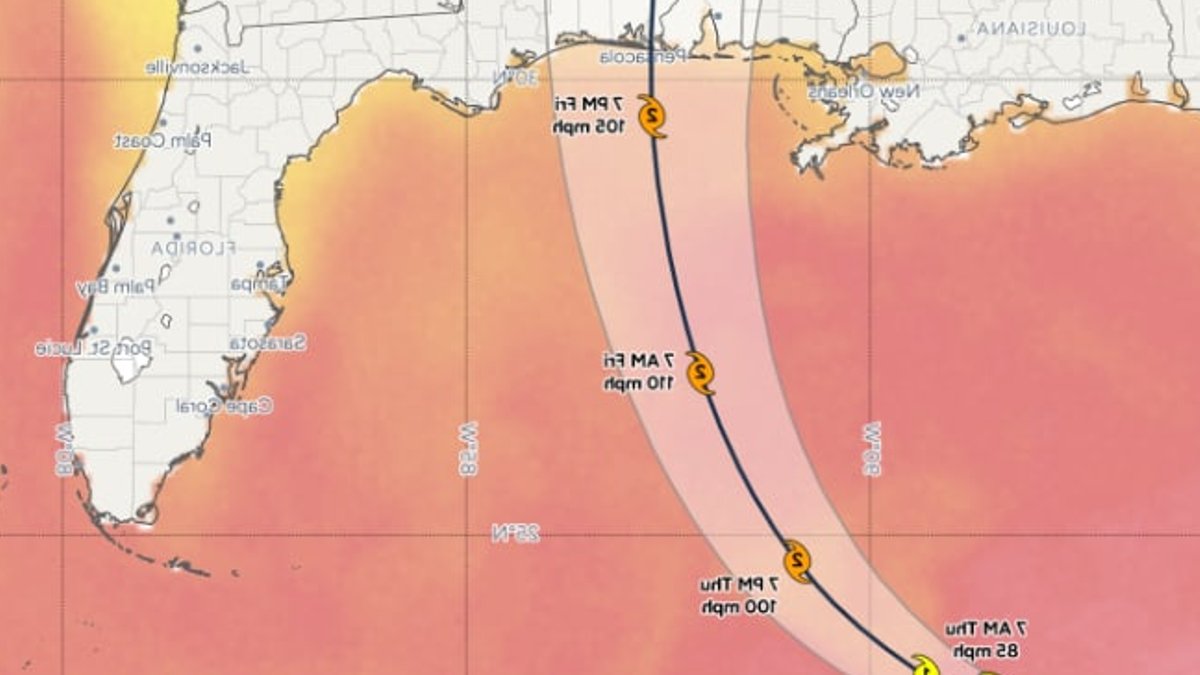
Hurricane Isaias strengthened overnight to become the first storm of the 2026 Atlantic hurricane season, with the National Hurricane Center (NHC) reporting sustained winds of 75 mph at 06:00 UTC on October 8th and a minimum central pressure of 981 mb. The system marked a historic milestone, forming earlier than any hurricane in over a century. Reinsurance broker Gallagher Re indicated that a Category 2 landfall along the U.S.
Tracking the Storm
The NHC forecast advisory stated that Isaias is expected to pass north of the Yucatan Peninsula later on October 8th before turning northeast and then north toward the northern Gulf Coast. The forecast cone has shifted eastward, with landfall anticipated between Mississippi and the Florida Panhandle. Satellite imagery suggests the storm remains somewhat lopsided, adding uncertainty to its intensity and path as it approaches the coast.
The NHC stated in its recent update, “On the forecast track, Isaias is expected to pass to the north of the Yucatan Peninsula later today and make landfall along the U.S. northern Gulf Coast within the warning area late Friday or early Saturday. “Aircraft data indicate that maximum sustained winds are near 75 mph (120 km/h) with higher gusts. Additional strengthening is expected through early Friday, and Isaias should remain a strong hurricane as it approaches the northern Gulf Coast on Friday night.
Potential Impacts and Loss Estimates
Impacts extend beyond the forecast cone, with high rainfall expected along the Gulf Coast and inland areas. Storm surge heights up to 7 feet and rainfall totals as high as 10 inches are possible. Tornado potential also exists within the storm’s outer bands. Gallagher Re emphasized that while location and track remain uncertain, historical data for Category 1 to Category 2 landfalls in the region suggest insured losses could reach the low to mid-single digit billions, covering private insurance and National Flood Insurance Program payouts. Economic losses, including uninsured damage, would likely be several billion dollars higher.
Gallagher Re also stated, “Recent Category 1 storms making landfall along the northern Gulf Coast have generated insured losses ranging from several hundred million dollars to the low-single digit billions (USD). Category 2 and Category 3 landfalls have generally resulted in materially greater insured losses, averaging into the low- to mid-single digit billions (in today’s dollars), particularly when surge impacts, prolonged power outages, or widespread inland flooding accompanied the event. The historical record also demonstrates that relatively small changes in landfall intensity or track can produce significant differences in ultimate loss outcomes due to varying exposure concentrations across coastal Louisiana, Mississippi, Alabama, and the Florida Panhandle.
Read Also: Eaton Vance ILS Holdings Hit $777 million
Market Reactions and Outlooks
Isacco Loconte, an insurance-linked securities (ILS) Investment Specialist at asset manager Azimut Switzerland SA, has posted some thoughts on hurricane Isaias on LinkedIn. Loconte said that there are stochastic events that imply higher loss levels for the insurance and reinsurance market, over the $10 billion level, but those events are few and considered outliers, with the vast majority of stochastic events similar to Isaias resulting in an industry loss of less than $5 billion.
Loconte said that the most similar stochastic event in the set was 1995’s hurricane Opal, a storm that weakened to a low Category 3 at landfall and drove an estimated industry loss of around $7.4 billion. But that is a stronger storm than hurricane Isaias is currently forecast to become, so the sub-$5 billion industry loss seems more reasonable if Isaias can only reach low Category 2 wind speeds.
Landfall Timing and Uncertainties
The NHC indicated landfall is expected late Friday into early Saturday, though timing could shift. A longer path through the Gulf might delay Isaias, while a direct route could accelerate it. The storm’s forward speed and intensity will influence the exact arrival time. Satellite data suggests continued uncertainty in its lopsided structure, complicating precise predictions.
Market Monitoring and Contract Triggers
Insurance-linked securities markets are watching Isaias closely, with some catastrophe bonds showing secondary trading activity. However, no distressed pricing or executed trades have occurred yet. Most structures are designed for stronger events, but certain parametric contracts could trigger if wind speeds exceed thresholds. Landfall location and exact intensity will determine which contracts activate.


