


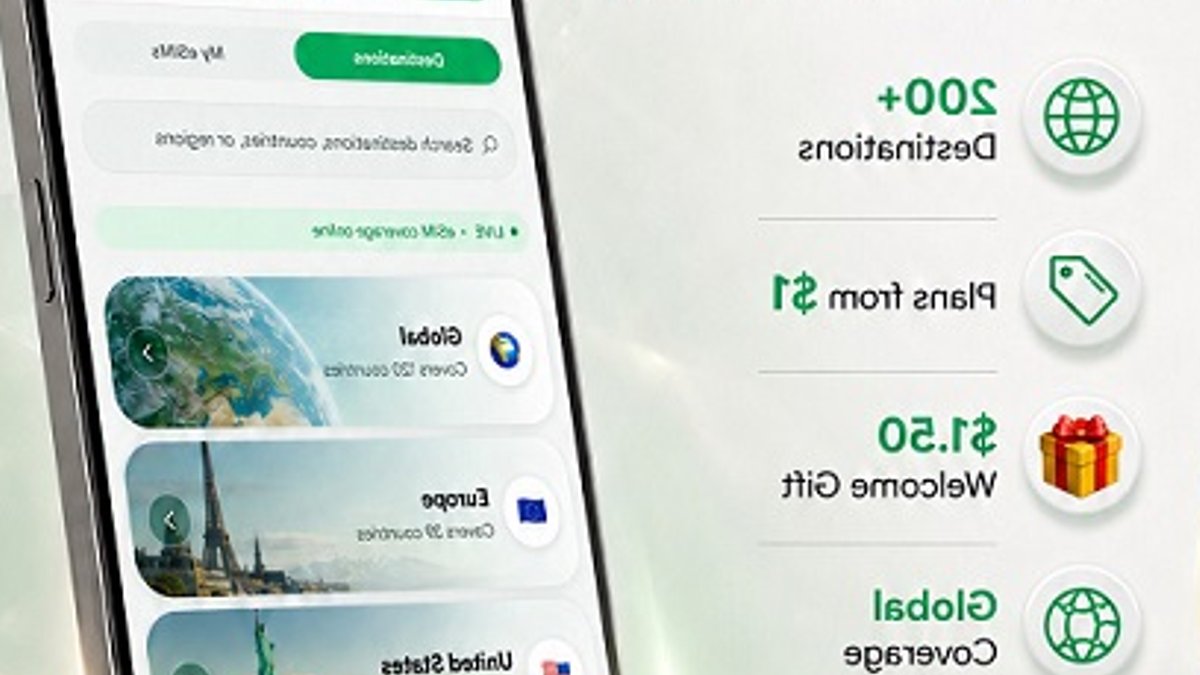
International mobile connectivity used to revolve around a familiar set of choices: activate an operator roaming package before departure, accept pay-as-you-go roaming charges, or buy a physical SIM card after landing. The rapid expansion of eSIM is adding another layer to that market.
Travellers can increasingly select, purchase and install mobile-data connectivity digitally before reaching their destination, changing not only the technology inside the phone but also the way international connectivity is distributed and sold.
eSIM Market Expansion
For African travellers and businesses, the implications extend beyond convenience. Business travel, tourism, diaspora movement, international study and remote work all depend increasingly on immediate access to mobile data, while airlines, banks, fintechs and travel platforms are gaining opportunities to embed connectivity directly into customer journeys.
GSMA data put global eSIM smartphone penetration at approximately 5% at the end of 2025, with penetration expected to reach around 10% by the end of 2026 and double again during 2027. The GSMA also expects smartphone connections using eSIM to outnumber those relying on traditional removable SIM cards by 2030.
International travel is emerging as one of the technology’s most visible consumer applications. According to GSMA Intelligence’s 2025 Global Consumer Survey, 12% of consumers who had travelled internationally during the previous 12 months used an eSIM while abroad.
Travel eSIM Model
For a traveller, the process can appear simple: choose a destination, compare packages, buy a plan, install an eSIM profile and activate it when needed. Behind that experience sits a more complex supply chain involving mobile operators, roaming and wholesale relationships, connectivity aggregators, digital platforms and customer-support systems.
Consumer-facing travel eSIM companies package this underlying network access into destination-specific, regional or global products. Their competitive challenge is therefore not only to obtain coverage, but to make plan selection, pricing, activation and troubleshooting simple enough for a traveller who may need connectivity immediately after arriving in an unfamiliar country.
A failed mobile-data connection after an international flight can prevent a traveller from accessing maps, ride-hailing services, banking, messaging, hotel details or work systems. For travel eSIM providers, customer support therefore becomes part of the core product rather than an after-sales function.
African Market Opportunities
One smaller company competing in this increasingly crowded market is AloFor S.R.L., a travel-tech platform registered and developed in Romania by Lebanese entrepreneur Ahmad Khodr. According to company information, AloFor currently offers mobile-data eSIM plans covering more than 200 destinations through country, regional and global packages.
AloFor says it has passed 1,000 new users, with 159 successfully fulfilled paid transactions across 66 distinct purchasing users as of 27 August 2026. Four of those transactions were for an African destination, Egypt, representing approximately 2.52% of fulfilled transactions and 6.06% of distinct purchasers in the dataset.
Khodr identifies Morocco, South Africa and Kenya alongside Egypt as markets with potential because they combine international travel flows with expanding digital-service adoption. He describes these as prospective markets rather than countries where AloFor is claiming meaningful commercial traction today.
The broader opportunity is likely to develop in several segments, including inbound tourists, business travellers, diaspora travellers, students and remote workers. For African businesses, the opportunity is also potentially larger than selling standalone data packages, as connectivity could become an embedded travel service.
Challenges and Opportunities
Khodr argues that the more sustainable differentiators for travel eSIM providers will be operational: simple plan selection, reliable provisioning, transparent pricing, effective localisation and fast support when something goes wrong.
For African digital businesses, the opportunity is to integrate travel eSIM into products that customers already use to organise and pay for international travel, such as flight bookings, travel cards or insurance products.


