


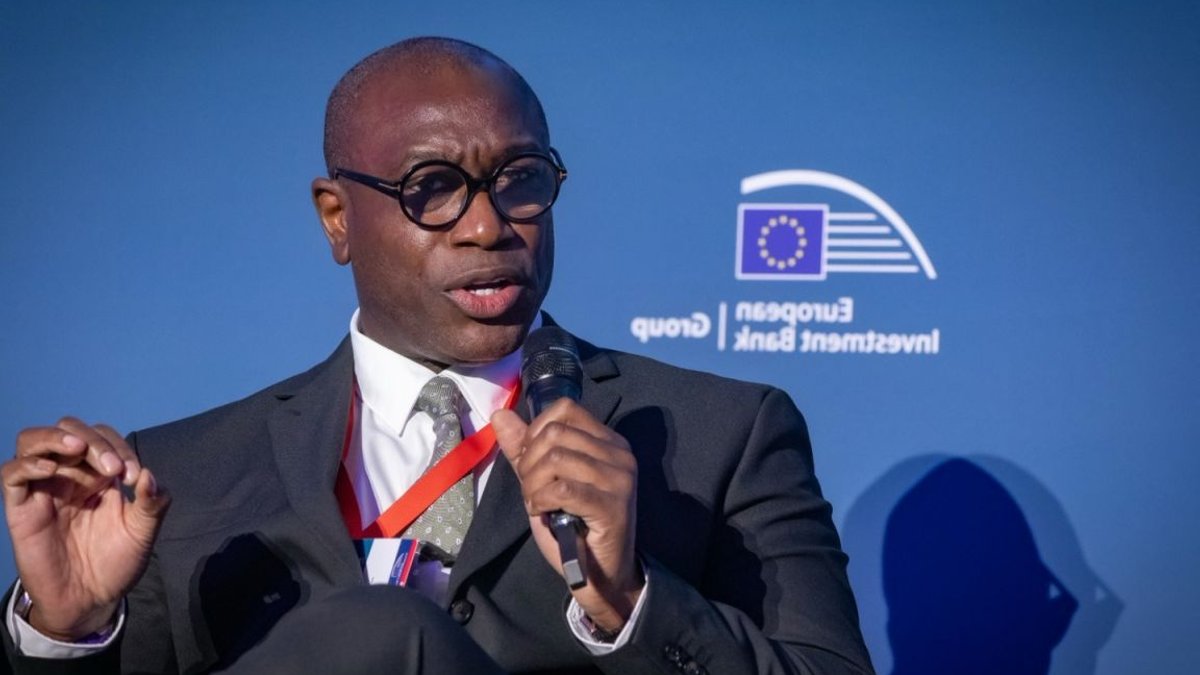
Africa is not short of capital, but of projects that institutional investors can actually fund, according to Dr. Hubert Danso, CEO and Chairman of Africa Investor Group. The continent’s financial setting is often misrepresented as one of scarcity, yet the real bottleneck lies in the absence of structured opportunities that meet the rigorous criteria of large-scale investors. Danso’s observations, delivered at the European Investment Bank’s €300 billion Global Gateway Forum, show a fundamental mismatch: while global institutional investors control more than $300 trillion in assets under management, Africa’s development finance system currently mobilizes only $0.20 to $0.38 of private capital for every public dollar invested. This ratio falls dramatically short of the long-standing target of $10 in private capital for every public dollar, a benchmark that has guided development finance strategies for decades.
Capital moves only when development is investable
“Capital does not move because development is persuasive,” Danso told the forum. “It moves when development becomes investable.” His statement cuts to the core of a persistent misconception in development finance—that the mere articulation of need or potential is sufficient to attract funding. In reality, institutional investors operate within tightly defined parameters, including risk-adjusted returns, liquidity constraints, and fiduciary responsibilities to their stakeholders. These requirements are not negotiable, nor are they unique to Africa; they apply universally to all markets where these investors deploy capital. The difference, Danso argued, lies in the existence of frameworks that transform development objectives into tradable, scalable assets.
He pointed to European instruments that have achieved ratios as high as €15 of private capital for every €1 of public money. These mechanisms did not emerge by accident but were the result of deliberate policy design, regulatory alignment, and the creation of standardized investment vehicles. Such models demonstrate that the tools to mobilize capital at scale exist, but they require adaptation to Africa’s specific economic and institutional contexts. The gap, Danso emphasized, is not about the availability of money but about the bankability of the projects on offer—whether they can be structured to meet the due diligence standards of pension funds, sovereign wealth funds, and other institutional players.
Institutional investors are not just passive funders, Danso said. They shape entire asset classes. The influence of these investors extends beyond the capital they provide; they actively define the contours of markets by setting benchmarks for risk, return, and impact. He cited historical examples including venture capital ecosystems pioneered by the Yale University Endowment, global infrastructure allocations by Canadian pension funds like CPP Investments, and responsible investment leadership by sovereign wealth funds such as Norway’s Government Pension Fund Global. These examples show that large-scale capital flows when structured, bankable investment frameworks exist.
Norway’s Government Pension Fund Global, the world’s largest sovereign wealth fund, provides another instructive example. With assets exceeding $1.4 trillion, the fund operates under strict ethical and financial guidelines, investing only in markets and assets that meet its risk and governance criteria. Its success lies not in the sheer volume of capital but in the disciplined application of investment principles, including transparency, accountability, and alignment with long-term economic trends. These examples illustrate a broader principle: large-scale capital flows do not materialize in a vacuum. They require legal and regulatory environments that protect investor rights, financial instruments that mitigate risk, and project pipelines that are sufficiently mature to absorb capital efficiently. Without these frameworks, trillions of dollars remain on the sidelines, even when the need is clear and the economic rationale compelling.
Related: Pope Leo XIV backs IIPP Africa finance pillar
Two priorities to close the gap
Danso outlined two steps to make African projects more attractive to institutional investors, both of which address structural barriers rather than superficial fixes. The first involves democratizing access to risk data for Global Emerging Markets (GEMs). Institutional investors, particularly those managing large portfolios, rely on granular, standardized data to assess opportunities and allocate capital. In many African markets, however, such data is either fragmented, outdated, or inaccessible, creating an information asymmetry that deters investment. Danso’s proposal would involve creating centralized platforms where investors can access real-time risk assessments, market trends, and project performance metrics. This would not only reduce the cost of due diligence but also enable investors to compare opportunities across regions and sectors with greater precision. For example, a pension fund considering an investment in West African renewable energy projects would benefit from standardized data on regulatory stability, off-taker reliability, and historical project performance, allowing it to make informed decisions without incurring prohibitive research costs.
The second priority centers on deeper partnerships between the European Investment Bank (EIB), the European Commission, the European Bank for Reconstruction and Development (EBRD), and institutional investors. These collaborations could focus on designing scalable, investable asset classes tailored to Africa’s development needs. One model Danso highlighted is Institutional Investor–Public Partnerships (IIPPs), which differ from traditional public-private partnerships (PPPs) by placing institutional investors at the center of project design. Unlike PPPs, which often involve ad-hoc agreements between governments and private firms, IIPPs are structured to align the interests of public institutions with those of institutional investors from the outset. This alignment could take the form of co-investment platforms, where public funds are used to de-risk projects, making them more attractive to private capital. For instance, the EIB could provide guarantees or first-loss capital to lower the risk profile of a large-scale infrastructure project, while institutional investors contribute the bulk of the funding in exchange for predictable returns. Such arrangements not only mobilize capital at scale but also ensure that projects are designed with commercial viability in mind, rather than as one-off development interventions.
The challenge is not theoretical. If African projects remain unstructured, even the most patient capital will stay away. Institutional investors are not philanthropic entities; they are bound by fiduciary duties to their beneficiaries, whether pensioners, policyholders, or sovereign wealth fund stakeholders. Their mandates require them to seek returns that justify the risks they take, and they cannot afford to invest in projects that lack clear revenue models, enforceable contracts, or exit strategies. The transformation of development projects into investable assets requires more than good intentions; it demands technical expertise, legal certainty, and financial engineering. For example, a renewable energy project in East Africa might have strong potential, but without a power purchase agreement (PPA) with a creditworthy off-taker, it will struggle to attract institutional capital. Similarly, a transportation project in Southern Africa may face delays or cost overruns if land acquisition processes are opaque or subject to political interference. These are not insurmountable obstacles, but they require proactive measures to address them before capital can flow.
Danso’s argument reflects a broader shift among development leaders, who increasingly recognize that the focus must move from capital mobilization to project preparation. The traditional approach—where development finance institutions (DFIs) and governments identify projects and then seek funding—has proven inefficient in many cases. Instead, the new paradigm involves engaging institutional investors early in the project design phase, ensuring that their requirements are embedded from the start. This shift is already underway in some regions. For example, the Africa50 infrastructure fund, backed by the African Development Bank and several African governments, has adopted a project development model that prioritizes bankability. By working with governments to structure projects that meet private sector standards, Africa50 has been able to attract institutional investors to initiatives that might otherwise have remained on the drawing board. Similarly, the Global Infrastructure Facility (GIF), a partnership between multilateral development banks and private investors, provides technical assistance to prepare projects for institutional investment, bridging the gap between development objectives and commercial viability.
“Once development becomes investable,” Danso concluded, “capital reallocates—by mandate, at scale.” His statement encapsulates the transformative potential of this approach. Institutional investors are not averse to risk; they are averse to uncertainty. When projects are structured to provide clarity on returns, risk mitigation, and exit options, capital will follow—not as charity, but as a rational allocation of resources. The key lies in creating the conditions where development and investment objectives align, ensuring that Africa’s infrastructure and industrial projects are not just necessary but also financially compelling.


